A small leak during a jump, a sneeze on the reformer, a dash to the loo halfway through class. At HARTMANN Direct, we specialise in bladder and bowel health, and through my work in continence care I hear from many women in their 40s and 50s who describe exactly these moments, often just as they are working hardest to stay strong and active. If that sounds familiar, I want you to know two things: bladder leaks in midlife are very common, and they are not something you simply have to put up with.
What I see again and again is two things overlapping. Hormonal changes around perimenopause and menopause alter the tissues that support bladder control. At the same time, the kind of exercise many of us love, from HIIT and running to core-heavy classes, places real demands on the pelvic floor. When the two meet, leaks can appear for the first time or get worse.
The encouraging news is that the pelvic floor is muscle, and muscle responds to training. In this article, I'll explain why leaks happen in menopause and during exercise, why a weak pelvic floor and an overactive one need different approaches, and how Pilates for pelvic floor strength can help you keep moving with confidence.
Why menopause affects bladder control
One of the first things I explain to women is that oestrogen does far more than regulate periods. The tissues of the vagina, urethra and bladder neck are rich in oestrogen receptors, and the hormone helps keep them thick, elastic and well supplied with blood. As levels fall through perimenopause and after the menopause, these tissues can become thinner, drier and less springy. Clinicians call this cluster of changes genitourinary syndrome of menopause (GSM). Up to half of postmenopausal women experience occasional leaks, yet relatively few seek treatment. Many women I speak to are surprised that changes can begin much earlier: perimenopause usually starts in the 40s and lasts four to eight years, and leaking when coughing or sneezing is one of its common symptoms.
Several things follow from that:
The urethral seal weakens. The lining of the urethra helps it close firmly. When that lining thins, the seal is less effective, so a cough or a lift is more likely to push urine past it.
Supporting tissue loses collagen. The connective tissue that holds the bladder and urethra in position becomes less robust, so the pelvic floor muscles have to do more of the work.
Muscle mass declines. From midlife, we gradually lose muscle unless we train it, and the pelvic floor is no exception.
The bladder can become more sensitive. Thinner tissue can make the bladder more irritable, leading to urgency and more frequent trips to the toilet.
This is why menopause is linked to two main types of leakage. Stress incontinence is leaking when pressure rises in the abdomen, such as when you laugh, sneeze, jump or lift. Urge incontinence is a sudden, strong need to go that is hard to hold. Many women experience a mix of both. Previous pregnancies, chronic coughing, constipation and weight gain in midlife can all add to the load.
Why exercise can trigger leaks
The way I like to describe it is to think of your trunk as a pressurised canister. The diaphragm forms the lid, the deep abdominal and back muscles form the walls, and the pelvic floor forms the base. Every time you exhale hard, brace, lift or land, pressure inside that canister rises. A well-functioning pelvic floor rises to meet it, closing the urethra at just the right moment.
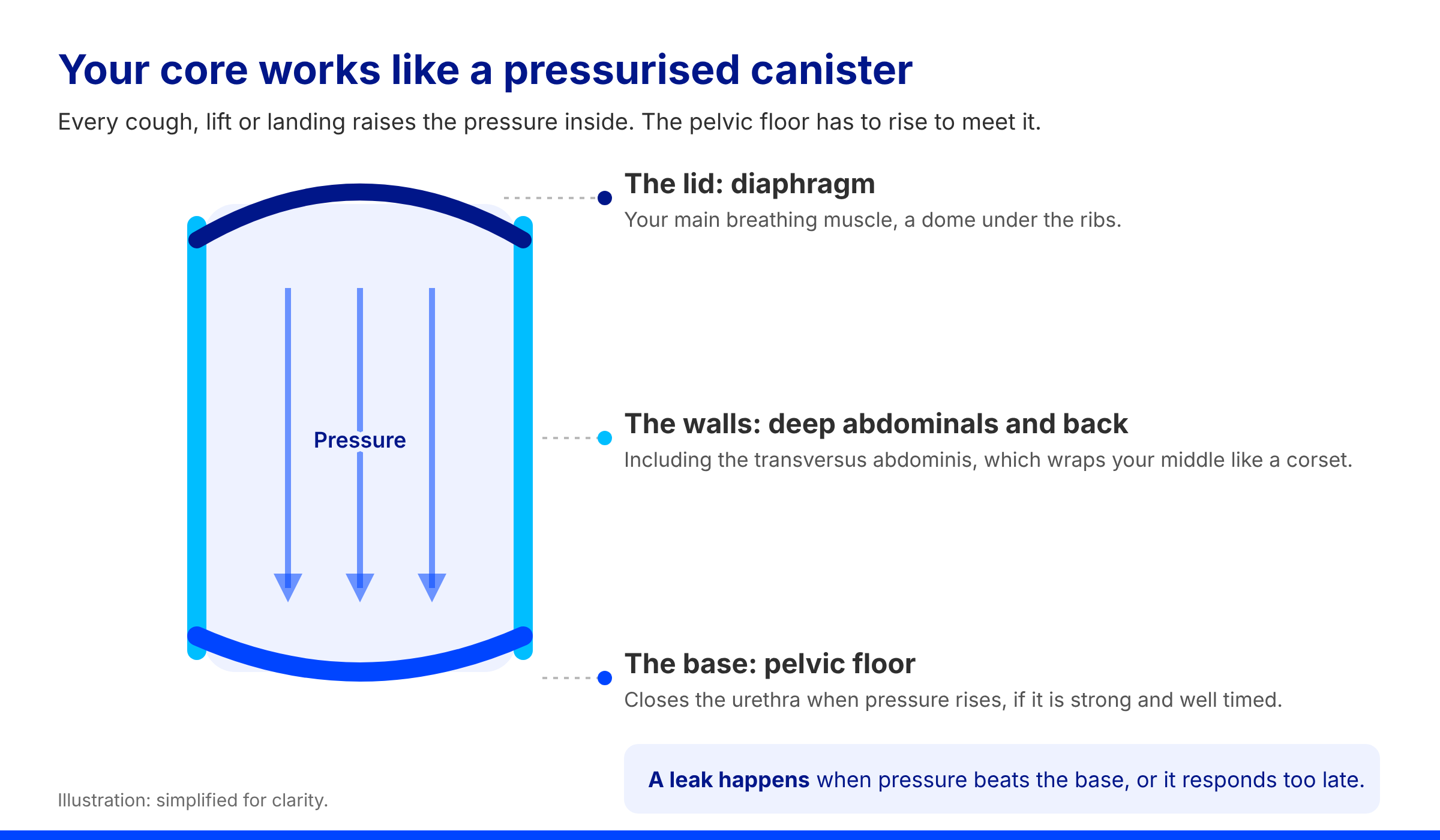
Leaks happen when the pressure arriving at the base is greater than the pelvic floor can match, or when the timing is off. Common triggers include:
High-impact movement. Running, skipping and jumping send repeated loads through the pelvic floor, often several times body weight on each landing.
Heavy lifting and breath-holding. Straining against a load without coordinating the breath drives pressure straight downwards.
Intense abdominal work. Repeated crunches, roll-ups or long holds can build pressure faster than the pelvic floor can respond, especially when the abdominal wall bulges or domes.
Fatigue. Like any muscle, the pelvic floor tires. Leaks that appear late in a session are often a sign of endurance, rather than strength, running out.
I often hear from active women who assume leaks only affect people who have had children, or that they must be doing something wrong. Neither is true. Leaking during exercise is common at every age, and in my view it is a sign that the system needs retraining, not that you should stop moving.
Weak or overactive? Why it matters
The usual advice for leaks is "do your pelvic floor exercises". For many women that helps. But one of the most common misunderstandings I come across is that every leaky pelvic floor is a weak one. It isn't. Some are overactive (also called hypertonic): the muscles are held tight much of the time and struggle to relax fully.
A muscle that never lets go cannot contract any further when it is suddenly needed. So an overactive pelvic floor can leak too, especially under load. Stress, habitual gripping of the tummy or bottom, and an "always switched on" approach to core work can all contribute.
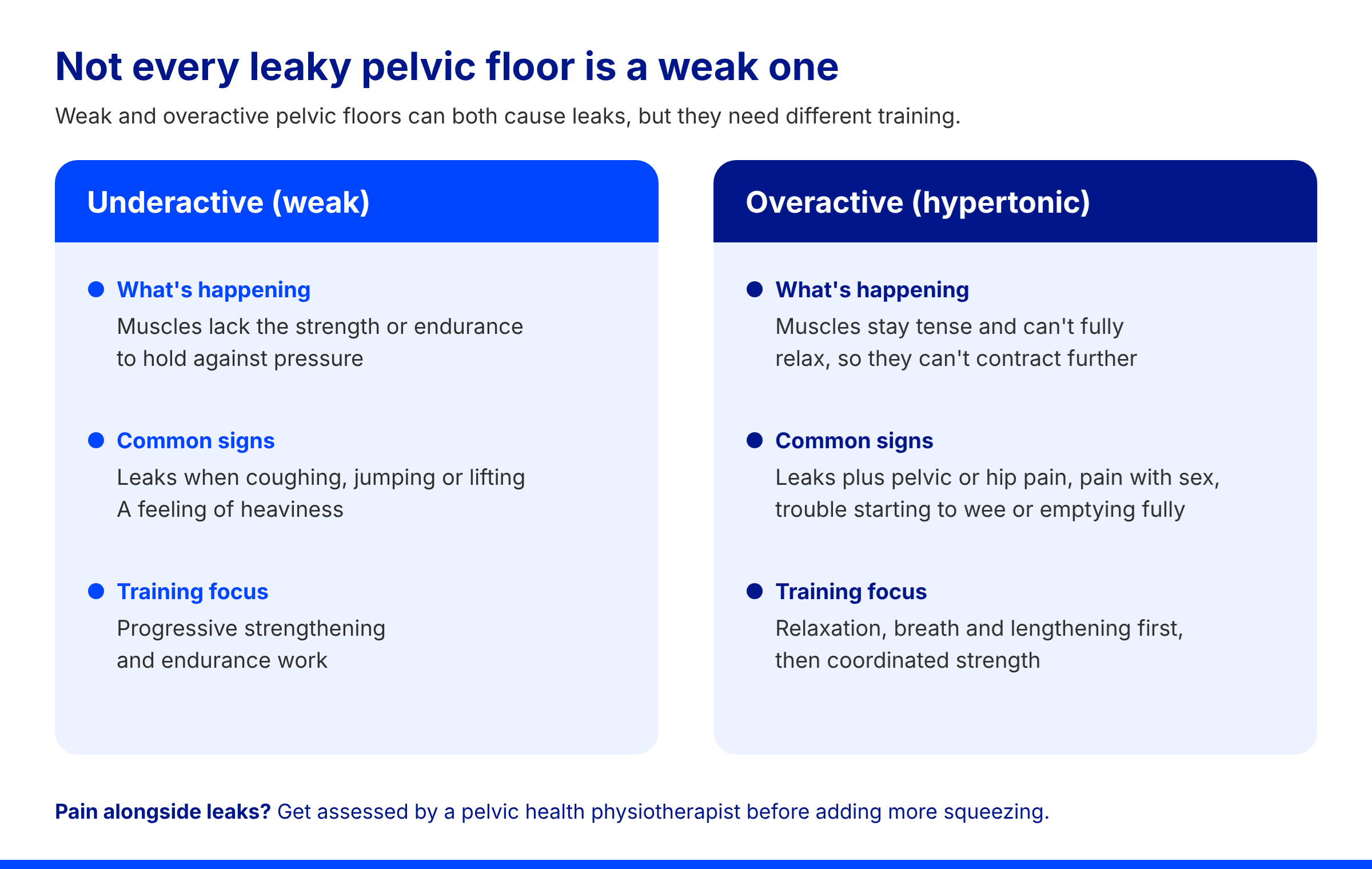
This is why I'm cautious about telling everyone to simply squeeze more. If you have pain alongside leaks, or exercises seem to make things worse, I'd always recommend getting assessed before adding more contraction work.
How pelvic floor Pilates can help
Pelvic floor muscle training is the recommended first step for stress and mixed incontinence in UK guidance, ideally supervised and kept up for at least three months. I think Pilates, sometimes called pelvic Pilates when it focuses on this area, offers a natural home for that training, because it already works on the things the pelvic floor needs most.
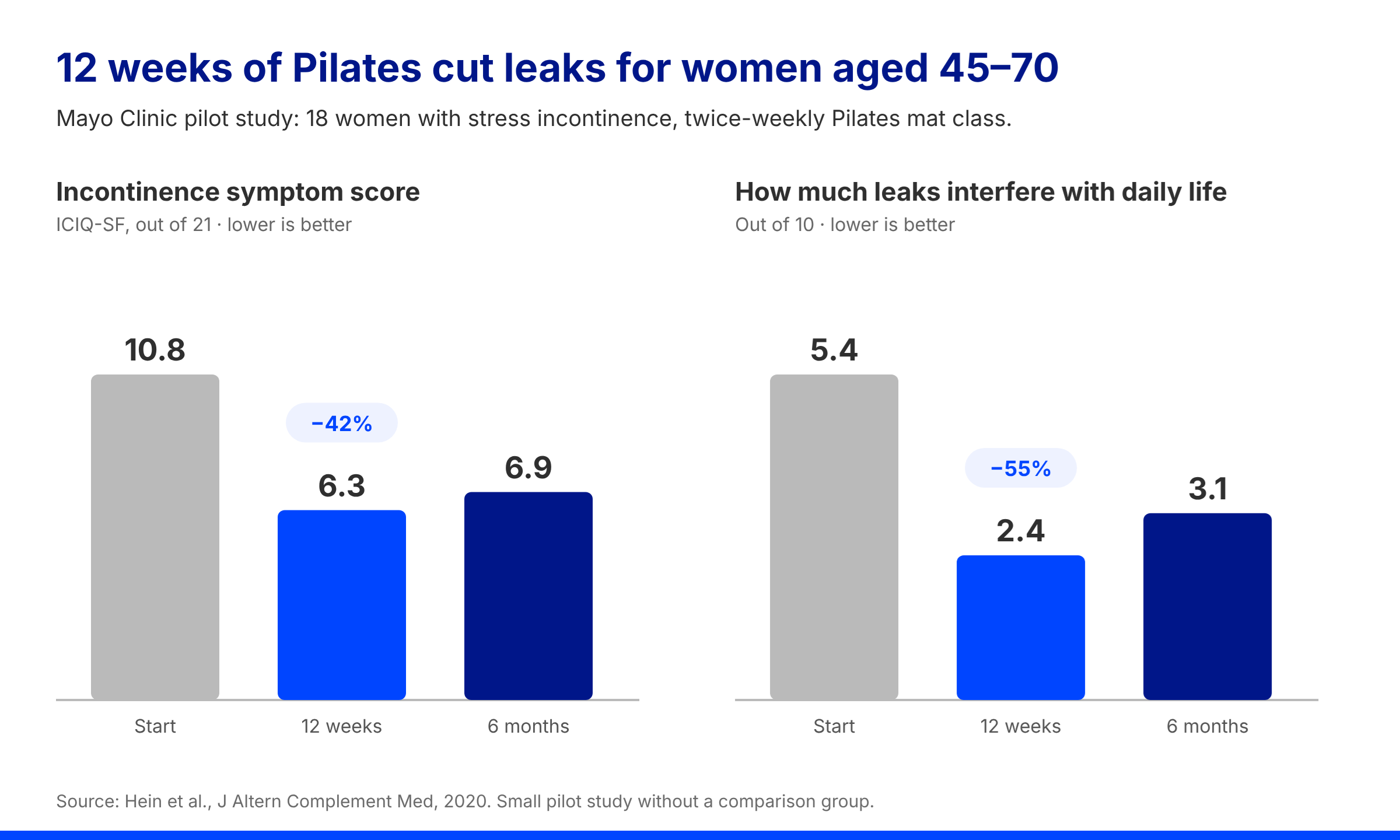
There is encouraging evidence for this too. In a Mayo Clinic pilot study, women aged 45 to 70 with stress incontinence took a twice-weekly Pilates mat class focused on the pelvic floor for 12 weeks. Their incontinence scores fell by around 42%, and how much leaks interfered with daily life dropped by more than half. Most of that improvement was still there six months later. It was a small study of 18 women without a comparison group, so it isn't the final word, but the researchers also noted something I think matters: women tend to give up on pelvic floor exercises at home, while a regular class makes it far easier to keep going.
Breath and pressure. Lateral breathing teaches the diaphragm and pelvic floor to move together: the pelvic floor gently lowers on the inhale and lifts on the exhale. Learning to "exhale on effort" helps manage pressure during harder moves.
Coordination, not just strength. Pilates links the pelvic floor with the diaphragm and the deepest abdominal muscle, the transversus abdominis, as well as the glutes and spine, so it switches on in time with movement rather than in isolation.
Release as well as lift. Good teaching emphasises letting go between repetitions, which is essential for anyone with an overactive pelvic floor.
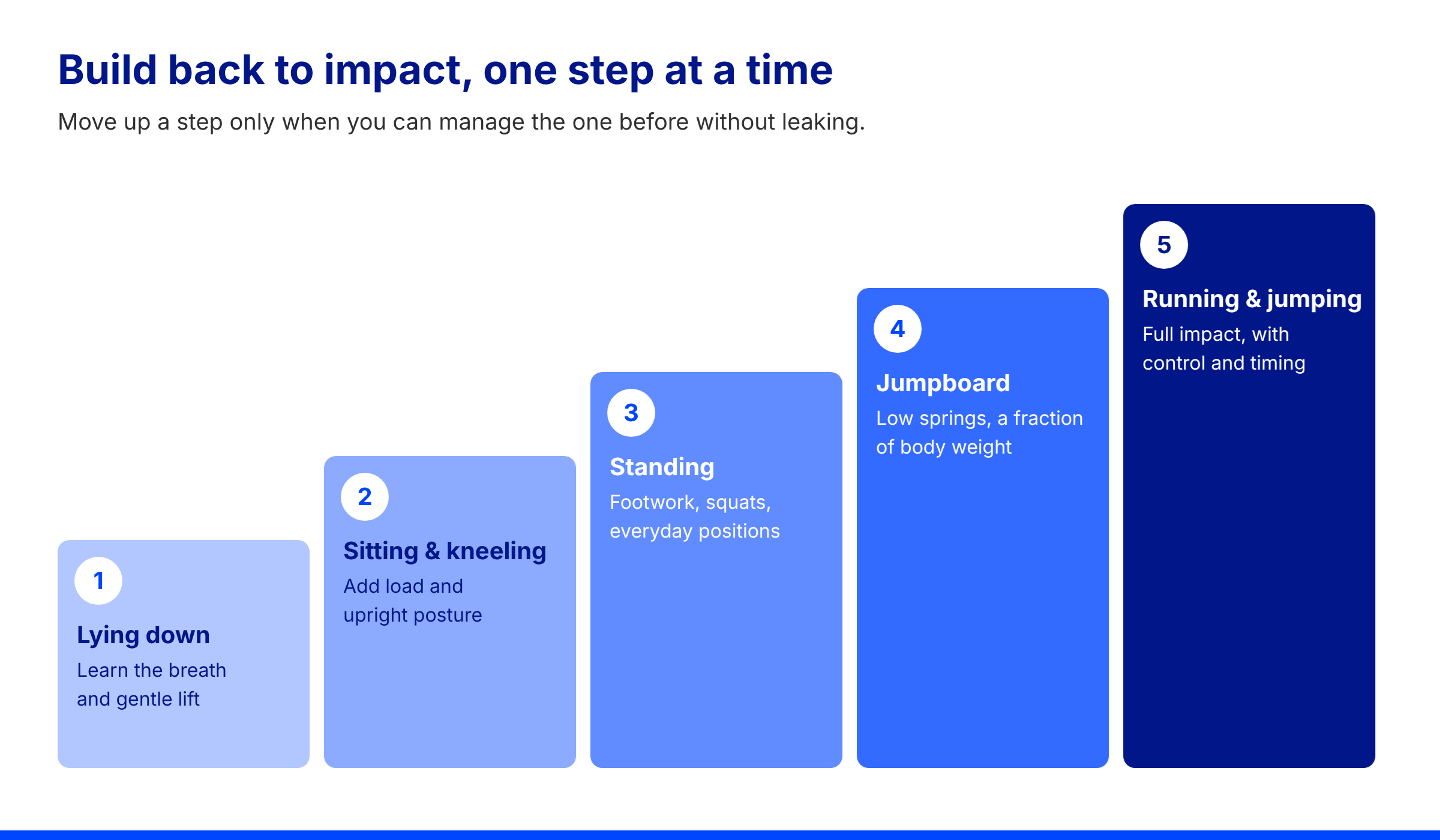
Progressive load. Exercises can start lying down with gravity reduced, then progress to sitting, kneeling, standing and eventually impact.
Strength around the pelvis. Strong hips, glutes and inner thighs share the load and support pelvic stability.
Posture and alignment. Slumping increases the downward pressure on the pelvic floor through the day. Pilates builds the awareness and strength to sit and stand taller, which takes some of that load off.
A calmer nervous system. Menopause can bring disrupted sleep, low energy and higher stress, and stress is one of the things that keeps an overactive pelvic floor switched on. Slow, breath-led movement helps the body settle, which makes it easier for the pelvic floor to let go.
From a continence point of view, the reformer is particularly useful. Springs can assist or resist, so the same movement can be made easier or harder in small steps. Footwork, bridging and side-lying leg work let you build strength under control, while jumpboard work offers a stepping stone towards impact at a fraction of body weight. For women in midlife, the added resistance also supports bone density and overall muscle mass, both of which matter more after the menopause.
Pilates exercises for the pelvic floor
These pelvic floor Pilates exercises are a good place to start, and your instructor can adapt them to suit you. They work on a mat or reformer and suit most women. Go gently, and stop if anything causes pain.
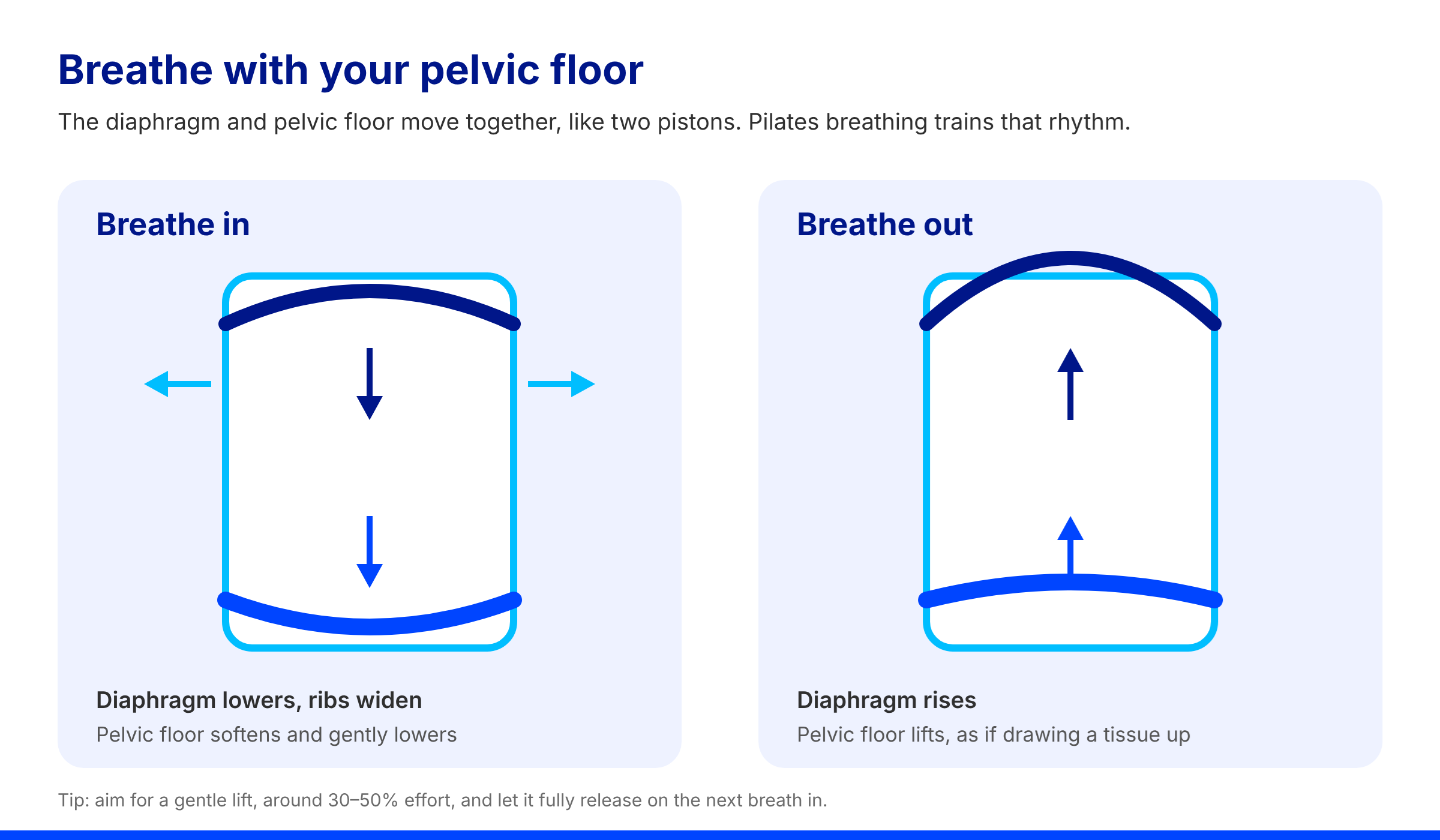
Connect with the breath. Lie on your back, knees bent. Breathe into the sides and back of the ribs. On the inhale, feel the pelvic floor soften and widen. On the exhale, gently lift it, as if drawing a tissue up from the floor. Fully release on the next inhale.
Quick and long holds. Practise both: slow lifts held for up to ten seconds, and quick lifts and releases. The slow holds build endurance; the quick ones train the reflex you need for a cough or a landing. Rest for twice as long as each hold, and keep breathing normally throughout.
Pelvic curl or bridge. Exhale and lift the pelvic floor, then roll the spine up into a bridge. Inhale at the top, exhale to roll down, then let everything relax. On the reformer, this can be done with feet on the footbar and light springs. Some research suggests the bridge activates the pelvic floor at least as well as isolated squeezes, which makes it a good staple.
Footwork on the reformer. Coordinate the exhale and gentle lift with each press out. Keep the movement smooth, and watch for breath-holding or bearing down.
Build towards impact. When you can manage these without leaking, progress to standing work, then to jumpboard at low spring settings before returning to running or jumping.
What we'd ask instructors and clients to look out for:
Watch for doming or bulging of the abdomen during core work. It is a sign to reduce the load.
Cue release as often as you cue contraction. Around 30 to 50 per cent effort is plenty for most pelvic floor work.
Swap or modify high-pressure moves, such as the hundred, full roll-ups or the Rollover, until control improves.
Fit pelvic floor work in little and often. A few minutes daily usually does more than one long session a week. Lying down is the easiest starting position, progressing to sitting and standing as strength improves.
Avoid practising by stopping the flow of urine. Doing this regularly can stop the bladder emptying fully and raise the risk of infection.
If leaks are a concern, look for an instructor with pelvic health training, or one who works alongside a women's health physiotherapist.
How often? A few minutes of simple pelvic floor work each day, plus two or three Pilates classes a week, is a good target. Even one class a week is worth doing if that's what fits around life.
Habits that help outside the studio: eat plenty of fibre to avoid constipation, try not to strain on the toilet, and cut back on caffeine, fizzy drinks and alcohol, which can irritate the bladder. Don't cut back on water, though: concentrated urine irritates the bladder too. If urgency is your main problem, bladder training (gradually stretching the time between toilet visits) can help, ideally with support from your GP or a continence nurse.
Keep training with confidence. Leaks shouldn't stop you coming to class while you build strength. One tip I share often: use a pad or liner designed for bladder leaks rather than a period pad. Continence products absorb urine much faster and lock in odour, so you can focus on your workout rather than worrying about it. At HARTMANN, for example, our MoliCare® Premium Lady Pads are a slim option for light leaks that sits discreetly under leggings, while MoliCare® Premium Lady Pants offer more absorbency for heavier leaks or longer classes. Whatever you choose, it's worth keeping a spare in your gym bag. Our guide to choosing products for yoga and exercise explains which options suit different classes and levels of leakage.
When to seek extra help
I always stress that Pilates works best alongside, not instead of, proper assessment. Speak to your GP, who can refer you to a women's health (pelvic health) physiotherapist or your local NHS continence service, if you notice:
Leaks that are getting worse or not improving after a few months of regular training
Pelvic pain, pain during sex, or pain when passing urine
A feeling of heaviness, dragging or a bulge in the vagina, which can be a sign of prolapse
Frequent urgency, needing to go at night, or recurrent urinary tract infections
Blood in your urine
A GP can also talk you through options such as vaginal oestrogen or HRT. These help some women, but they are not right for everyone, so the decision is best made together with your GP. Many women find the best results come from combining medical support with consistent exercise.
For more on why bladder changes happen in midlife and the different ways to manage them, our HARTMANN Direct guide to managing incontinence during menopause is a good next read, and one I often point women towards.
Moving forward with confidence
Bladder leaks in menopause and during exercise are common, understandable and, in most cases, very treatable. Falling oestrogen changes the tissues that support continence, and demanding exercise asks more of the pelvic floor. But I'm firmly of the view that neither has to mean giving up the movement you enjoy.
With a thoughtful approach to Pilates for pelvic floor health, built around breath, coordination, release and gradual progression, many women regain control and keep training for years to come. It's never too late to start, and small, consistent changes add up. For instructors, a little extra awareness of pelvic health can make a real difference to clients who may never have felt able to mention it. If there's one thing I'd like you to take from this article, it's that starting the conversation is often the first step.