
Reformer Pilates During Pregnancy: Safe Exercises by Trimester (UK Guide)
You've just found out you're pregnant, and one of the first things you've googled is whether you can keep going to your reformer classes. Or maybe you're not yet a regular and you've heard that reformer Pilates during pregnancy is one of the best things you can do for your body right now. Either way, you want a straight answer, not a wall of disclaimers.
Most guides on this topic either tell you nothing specific or hand you a list of exercises without explaining the reasoning behind them. That's not useful when the stakes feel high and you're trying to make an informed decision about your body.
Here is what you actually need to know, broken down by trimester, with the modifications that matter and the exercises worth avoiding.
Key Takeaways
Reformer Pilates is broadly safe during pregnancy for healthy women, and aligns with RCOG guidelines of 150 minutes of moderate exercise per week.
The reformer's adjustable spring resistance and flexible positioning make it better suited to pregnancy than mat-based work.
From around 19 to 20 weeks, extended supine lying should be avoided. Side-lying, kneeling, and supported reclined positions replace it.
Crunches, sit-ups, oblique curls, prone positions, and standing on the carriage should be avoided throughout pregnancy.
Always disclose your pregnancy to your instructor, and choose a studio where instructors hold a recognised prenatal qualification alongside their Level 3 Reformer Pilates certification.
Many women practise safely up to their due date. There is no fixed cut-off, only appropriate modifications.
Is Reformer Pilates Safe During Pregnancy?
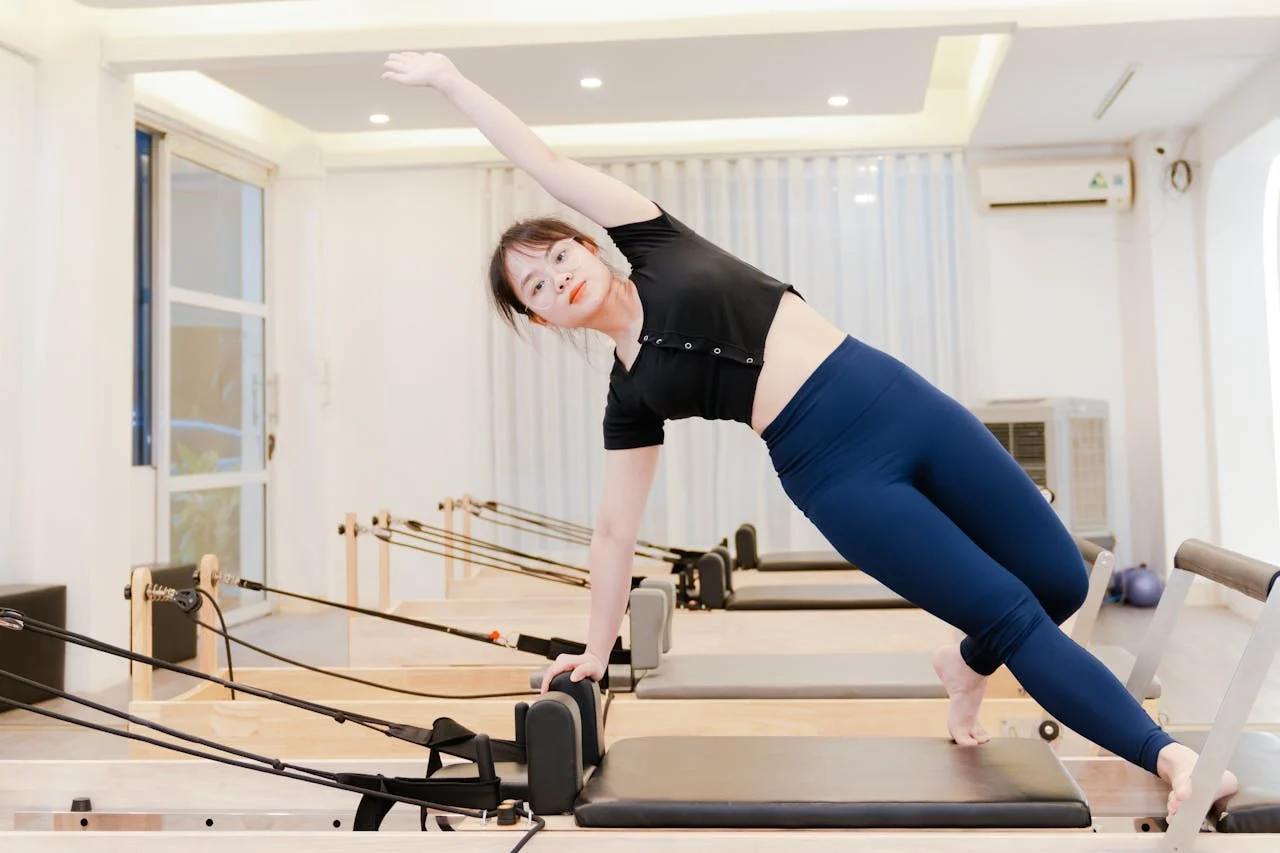
Reformer Pilates is broadly considered safe during pregnancy for women who are otherwise healthy and have no complications. The Royal College of Obstetricians and Gynaecologists (RCOG) recommends 150 minutes of moderate-intensity exercise per week during a healthy pregnancy, along with muscle-strengthening work twice a week. Reformer Pilates sits squarely within those guidelines.
The reformer itself is particularly well-suited to pregnancy because of its adaptability. The spring-resistance system can be dialled down to support movement rather than resist it, which is exactly what you need on a low-energy day at 30 weeks. It also allows a far wider range of positions than mat-based work, which becomes significant once lying flat on your back is no longer recommended.
One important caveat: attending a standard group reformer class without disclosing your pregnancy, or attending a studio whose instructors have no prenatal training, is not the same thing. The exercises need to be modified. The instructor needs to know. If you are new to reformer Pilates, start with one-to-one sessions before joining any group format.
Always consult your midwife or GP before beginning or continuing any exercise programme during pregnancy, particularly if you have any complications, pelvic girdle pain, or a history of miscarriage.
The Benefits That Actually Matter During Pregnancy
This is not just about staying active. There are specific reasons why reformer Pilates performs well as a prenatal exercise choice.
Pelvic floor and core support. As your baby grows, the load on your pelvic floor and deep abdominal muscles increases significantly. Reformer Pilates targets these structures in a way that most gym workouts do not, helping reduce the risk of pelvic girdle pain and lower back issues, which affect a substantial proportion of pregnant women in the UK.
Posture correction. The postural shifts of pregnancy are predictable: rounded shoulders, increased lumbar curve, a shifted centre of gravity. Exercises like kneeling arm series and seated footwork directly counter these changes.
Labour preparation. Awareness of the breath and the ability to relax the pelvic floor on demand are skills that take time to develop. Reformer Pilates, practised consistently, builds both. The Pelvic, Obstetric and Gynaecological Physiotherapy group (POGP) specifically recommends mind-body exercise during pregnancy for these reasons.
Adaptability to how you actually feel. Some days you will have energy. Many days you will not. Because spring resistance is adjustable, the same exercise can be performed at full load in your first trimester and at assisted load in your third.
First Trimester (Weeks 1–12): Build the Foundation
During the first trimester, most of your usual reformer repertoire remains appropriate. Your bump is not yet a physical constraint, and moderate-intensity exercise is well-supported by the evidence. The focus here is on building strength and body awareness before the physical demands of later pregnancy increase.
What to focus on:
Footwork in all its variations is an excellent place to start every session, strengthening the glutes, quads and calves while the core works to stabilise. The Feet in Straps series, including lifts, lowers, circles and frog, develops hip mobility alongside deep abdominal engagement. Knee stretches in kneeling position build arm and shoulder strength, which will serve you well when you are carrying a baby.
Key modifications at this stage:
Avoid overheating. Your body temperature regulation is already working harder, so keep the studio cool and stay hydrated. High-intensity intervals and breath-holding techniques are out. Moderate effort, controlled movement, and attention to how you feel is the right register.
Fatigue is common in the first trimester even when nothing else has changed. Reduce intensity or session length on difficult days without guilt. Two to three sessions per week is appropriate and sustainable.
Second Trimester (Weeks 13–26): Adjust for the Bump
This is the trimester where modifications become necessary rather than optional. From around 19 to 20 weeks, the weight of the uterus in a supine position can compress the inferior vena cava, reducing blood return to the heart and potentially causing dizziness or reduced placental blood flow. Lying flat on your back for extended periods is therefore no longer recommended.
This is not a reason to stop exercising. It is a reason to change your positions.
What works well:
Side-lying footwork and glute series on the reformer become your best friend here. These exercises strengthen the lateral glutes and thighs in a position that is both safe and genuinely comfortable with a growing bump. Kneeling arm series, facing sideways on the carriage for added stability, continues to develop shoulder and trunk strength. Scooter, in a standing lunge position, works the glutes and single-leg stability without any supine loading.
If you do use a reclined position, a foam wedge under the back to raise the upper body to at least a 45-degree angle makes it safe for short periods.
What to start avoiding:
Sit-ups, crunches and traditional curl-up exercises increase intra-abdominal pressure and the risk of diastasis recti (abdominal separation). This is not just about avoiding discomfort; it is about protecting the integrity of the abdominal wall during a period when it is already under significant strain.
Third Trimester (Weeks 27–40): Prepare for Birth
By the third trimester, you may be managing discomfort alongside the desire to stay active. Upper back stiffness is common as the ribcage flares and the weight of the baby pulls forward. Balance becomes less reliable. Some exercises that felt manageable at 25 weeks will no longer feel appropriate at 35.
What works well:
Footwork with a wedge continues to build leg strength safely. The mermaid stretch on the reformer, sitting sideways and reaching into a side-bend, relieves the lateral tightness that builds under the ribs and around the lower back. Arm arcs and arm openings, supported by a gym ball wedged against the shoulder pads, mobilise the upper back with excellent support.
Pelvic floor work deserves more attention here than at any other stage. Both strengthening and conscious relaxation of the pelvic floor prepare the body for birth and recovery. Your instructor should be able to guide you through the coordination of breath and pelvic floor engagement during exercises.
What to avoid:
Standing on top of the reformer carriage is not appropriate in the third trimester. Your centre of gravity has shifted and your balance is less reliable. The risk of a fall is not worth taking. Similarly, the jumpboard in a supine position places too much load on the abdominals and should be avoided entirely.
Keep sessions at two to three per week. Listen to your body. Many women continue reformer Pilates safely up to and including their final weeks of pregnancy, but only with appropriate modifications in place.
Exercises to Avoid Throughout Pregnancy
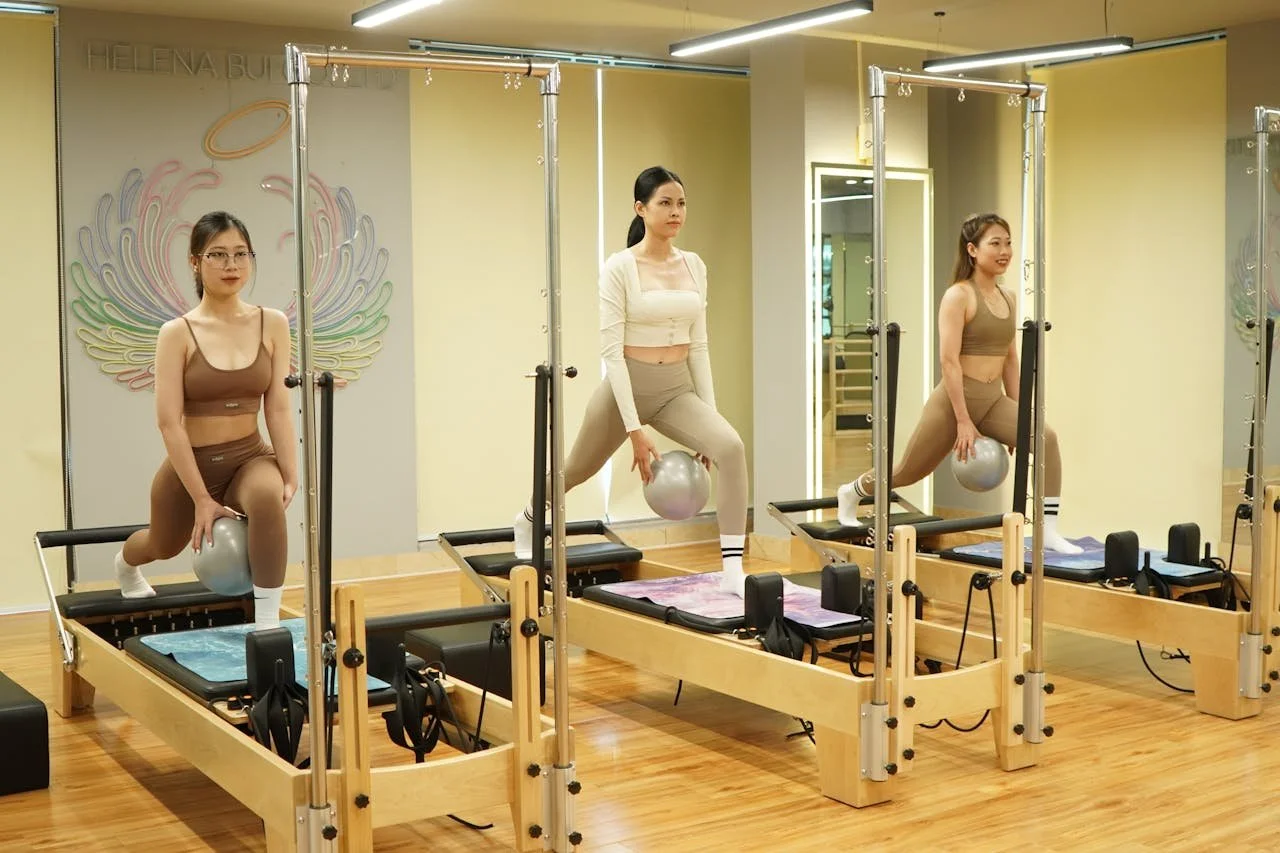
Regardless of trimester, some exercises are best avoided once you know you are pregnant:
Prone (stomach-down) positions become physically impossible as the bump grows and should be swapped out early rather than waiting until they become uncomfortable.
Supine positions for extended periods after 19 to 20 weeks, as outlined above.
Deep abdominal work including crunches, oblique curls and traditional Pilates roll-ups, which load the abdominal wall in ways that are counterproductive during pregnancy.
High-kneeling and standing on the carriage as pregnancy progresses, particularly in the third trimester.
Exercises involving breath-holding or Valsalva manoeuvre, which increase intra-abdominal pressure.
Finding the Right Studio in the UK
Not all reformer studios are equipped to offer prenatal classes, and the quality of prenatal training among instructors varies considerably. When you are looking for a studio, it is worth asking whether instructors hold a recognised prenatal fitness qualification alongside their Level 3 Reformer Pilates certification.
The Reformer Pilates Studio Directory is a useful starting point for finding pre- and post-natal class options across the UK. Studios listed aspremium-featured studios typically offer a broader range of specialist classes, including prenatal provision.
If you are considering instructor training yourself, our Level 3 Reformer Pilates qualification programme covers the scope of practice endorsed by recognised UK industry bodies, including pre- and post-natal considerations.
Frequently Asked Questions
What Pilates moves should be avoided during pregnancy?
Avoid crunches, sit-ups, oblique curls, prone (belly-down) positions, extended supine lying after 19 weeks, standing on the reformer carriage, and any exercise involving breath-holding. These either load the abdominal wall in a way that risks separation or reduce blood flow to the baby.
Is Pilates good for high cortisol?
Yes. Mind-body exercise like Pilates has been shown to reduce cortisol through controlled breathing, focused movement and parasympathetic nervous system activation. Regular sessions two to three times per week can support stress regulation during pregnancy when cortisol levels are naturally elevated.
How many weeks pregnant should I stop Pilates?
There is no fixed cut-off. Many women practise reformer Pilates safely right up to their due date with appropriate modifications. The key is working with a prenatal-qualified instructor, keeping exercise at a moderate intensity, and stopping if you experience pain, dizziness, or any unusual symptoms.
What is better for pregnancy, yoga or Pilates?
Both have merit, but reformer Pilates offers a stronger case for physical conditioning. It provides resistance-based strength work for the pelvic floor, core, and postural muscles that yoga typically does not. Yoga tends to offer more in terms of relaxation and flexibility. Many women find a combination of both works well.

Author
KARL KNIGHTS
Leading commercial operations for Reformerpilates.com. A pioneering platform transforming the global Reformer Pilates industry. Our mission is to revolutionise how studios, instructors, and enthusiasts connect, creating a vibrant community and driving business growth in the rapidly expanding wellness market.