Reformer Pilates is one of the fastest-growing corners of boutique fitness, and as more studios open, where you open matters more than ever. Footfall is usually the first number people ask about, but it's only the start. The best location isn't the busiest one. It's the one where the right people pass by at the right times and keep coming back.
What makes a studio successful?
Most of what makes a studio thrive has nothing to do with location: great instructors clients will follow, a consistent experience from booking to cool-down, a genuine sense of community, a timetable that fits clients' lives, and membership structures that reward loyalty. In a membership business, retention is everything. A good location makes all these easier. It puts you in front of people likely to become regulars, at times that suit them, in surroundings that support your brand.
Owners know it, too. In ReformerPilates.com's 2025 survey of 126 studio owners, 43% named securing the right space as a major hurdle when opening their studio, second only to finding qualified instructors (50%).
To show what this looks like in practice, Fetch Analytics used its location intelligence platform, Terain, to look at PilatEASE, winner of Best Studio of the Year (North East) at the 2026 Reformer Pilates Studio Awards.
Competition and neighbours: is it the right environment?
It's natural to see nearby studios as a threat, but they're often a signal. A cluster of fitness brands, speciality coffee shops, health food outlets and athleisure retailers suggests an area already draws health-conscious people with money to spend. Competition can grow the whole market. When several wellness businesses sit together, the area builds a reputation as a destination, and everyone benefits. What matters is who your neighbours attract, and whether there's room for what you offer. A cycling studio next door might send you clients looking for low-impact cross-training; a third Reformer studio on the same street is a different conversation.
Around PilatEASE, local residents' fitness visits span dance schools, martial arts clubs, personal trainers and leisure centres, with the most-visited venue a performing arts and fitness academy less than 1km from the studio. Yoga and Pilates account for only around 5% of those visits, pointing to an active local population with few direct alternatives to what the studio offers.
Being part of their daily journey
Loyal clients rarely make a special trip. You fit into their routine. The most successful studios catch people on journeys they already make: before work near transport hubs, at lunchtime within walking distance of offices, and after work on the route home. When your studio sits on that path, a class becomes a habit rather than a decision, and habits drive the repeat visits that sustain a membership base.
The streets outside PilatEASE show how this works in practice. Footfall picks up from 6am, and the 7–9am window carries around 15% of the day's passers-by. It then holds steady through the afternoon rather than spiking at midday, making early-morning classes a genuine option alongside daytime sessions.
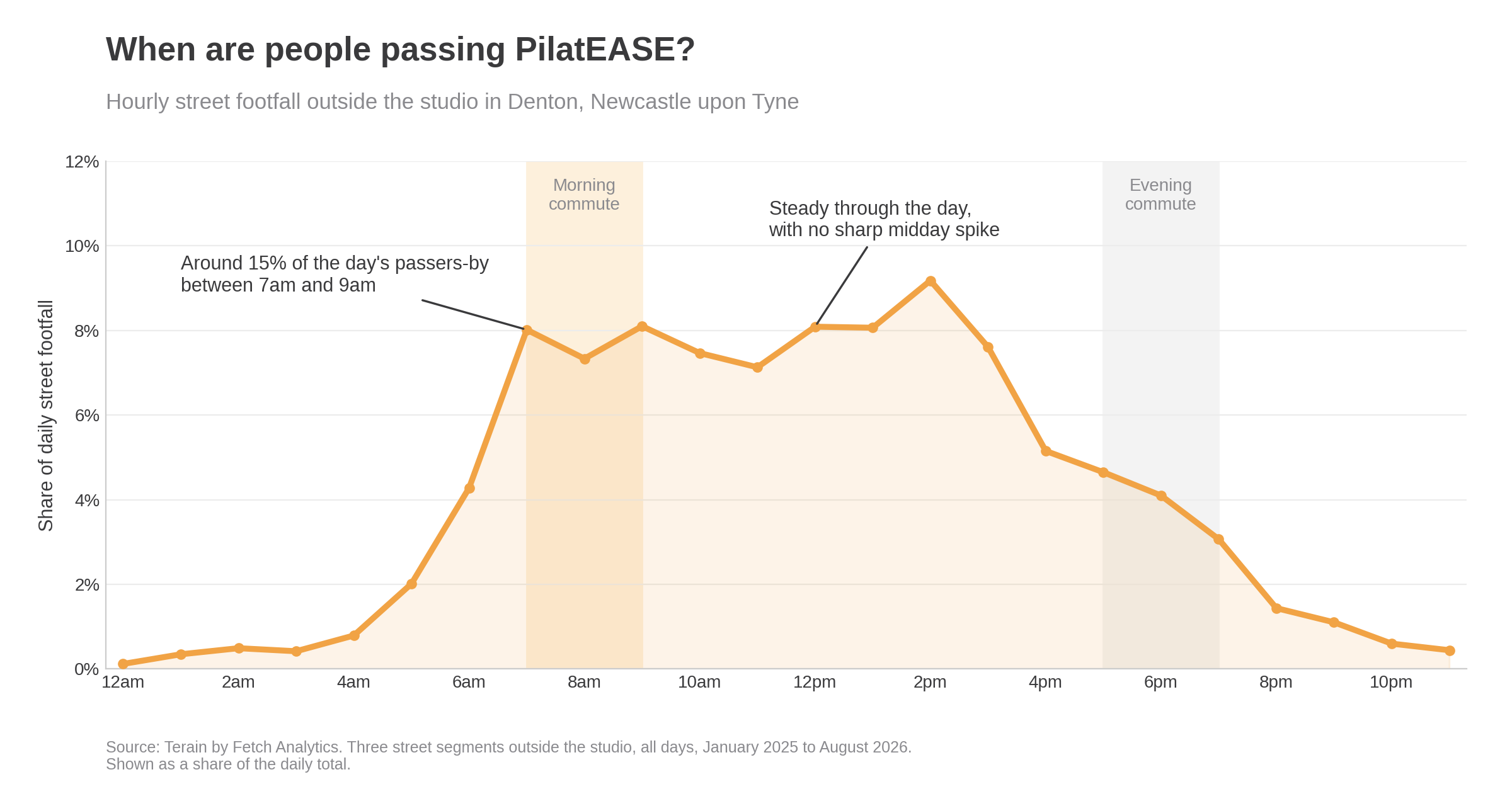
Hourly street footfall outside PilatEASE, January 2025 to August 2026. Source: Terain by Fetch Analytics.
You don't need everyone, just the right people
Studio software provider StudioGrowth estimates that an established boutique studio with six to eight reformers typically runs on around 100–150 active clients.
That number is often smaller than people expect. A Reformer studio doesn't need thousands of passers-by. It needs a committed core who come back again and again.
And those regulars come often: ReformerPilates.com identifies eight classes a month, roughly two a week, as its most popular membership tier for regular clients.
This is where quality beats quantity. A site with huge footfall but the wrong audience will underperform a quieter location surrounded by the right people. The question isn't “how many people are here?” but “how many of the right people, and how often?”
Understand your demographics: who lives there, and who visits
Resident data only tells half the story. A city-centre site may have few residents but thousands of weekday office workers; a suburban high street may be quiet midweek and busy with families at weekends. Knowing both who lives nearby and who actually visits lets you shape your offer around real demand: mobility-focused classes for older adults at off-peak times, student packs, early and late slots for professionals, mid-morning sessions after the school run. Tailored sessions fill quieter slots and build a timetable that reflects your community rather than guesswork.
At PilatEASE, around a third of residents in the surrounding postcodes are aged 15–34, but they make up a much smaller share of visitors, while over-65s account for nearly a quarter of visitors, almost double their share of the local population. That suggests untapped demand among younger locals, who could be reached with early-morning and evening slots, intro offers and student packs.
Time of day and day of week
Footfall isn't constant. An area buzzing on Tuesday lunchtime may be empty on Sunday morning, and vice versa. Visit patterns by hour and day show when potential clients are around, and whether that matches your timetable. It's also worth asking what draws people in at those times: a weekend market, a school, a commuter station. Aligning peak classes with an area's natural rhythm means fuller classes and less wasted instructor time.
Know your catchment and where to market
A catchment is where your clients come from, and it's rarely a neat circle on a map. Transport links, commuting patterns and neighbouring towns all shape it. Knowing where visitors travel from shows how far clients will realistically travel, which neighbourhoods deserve your marketing spend, and where a future second site might work. Instead of spreading budget thinly, you can target the communities already visiting the area.
PilatEASE draws nearly two-thirds of its visits from homes within 3km, and around nine in ten from within 10km. Newcastle upon Tyne accounts for more than three-quarters of visits, with smaller shares from neighbouring Northumberland and Gateshead
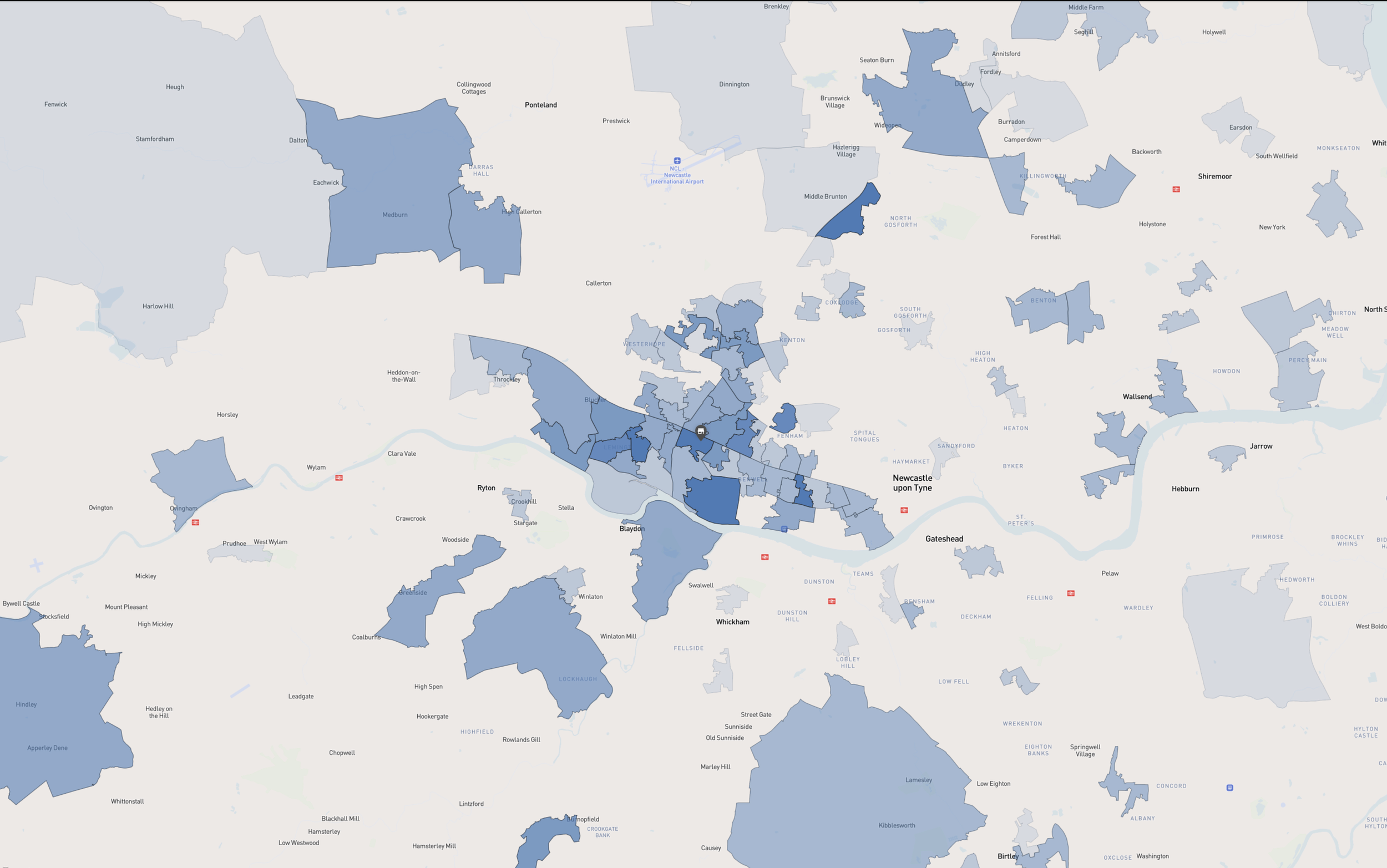
Where PilatEASE's visitors come from, January to September 2026. Darker areas indicate more visitors. Source: Terain by Fetch Analytics. Map data © Mapbox © OpenStreetMap.
A destination, not an impulse buy
A Reformer studio is a destination. Few people walk past and book a class on a whim. Visibility builds awareness, but once clients know you're there, they'll seek you out. That matters when weighing up rent. Prime high street units come at a premium, and much of that passing trade will never convert. A first-floor unit, a side street or a mixed-use development can offer far better value, provided it's within reach of the right audience. The aim is to balance lease cost against genuine demand, not to buy the busiest pavement.
Location insight doesn't stop on opening day
Competition, daily journeys, demographics, timing, catchment and the trade-off between rent and visibility are all vital when choosing a site. The same insight stays valuable once you're open: refining your timetable, launching targeted classes, focusing marketing where it counts, tracking how your area changes, and finding the right spot for studio number two. Footfall tells you how many people there are. Location intelligence tells you who they are, when they come, where they're from and whether they're likely to become your next loyal client.
Data note: Terain data covers January–September 2026.
About Fetch Analytics
Fetch Analytics is a location intelligence company operating in the UK and South Africa. Their platform, Terain, turns anonymised, aggregated mobile GPS data into insight on footfall, catchment and demographics, showing how people move, shop and visit across millions of locations, with no cameras involved. They work with retail, real estate, out-of-home media and public-sector teams, helping them understand high streets, town centres, shopping centres and store locations. For studio owners, the same insight shows whether a location attracts the right clients, at the right times, from the right places, both before you sign a lease and long after you open your doors. Want to see what the data says about your studio or your next location? Visit fetchanalytics.ai to book a Terain demo.
30 Blogs in 30 Days
Throughout October, we’re sharing one new blog every day, bringing together studio owners, instructors and industry experts to share their experiences, knowledge and perspectives on the Pilates industry.
Day 22 of 30, come back tomorrow for the next blog.